

Where to look
From a card’s menu you get three views:View Activity
The customer’s full timeline: entries, moves, calls, chats, sequences, and evaluations.
Move History
Only the stage changes, with the move type and who did it.
Processing History
Every transition evaluation, including the ones that decided not to move.
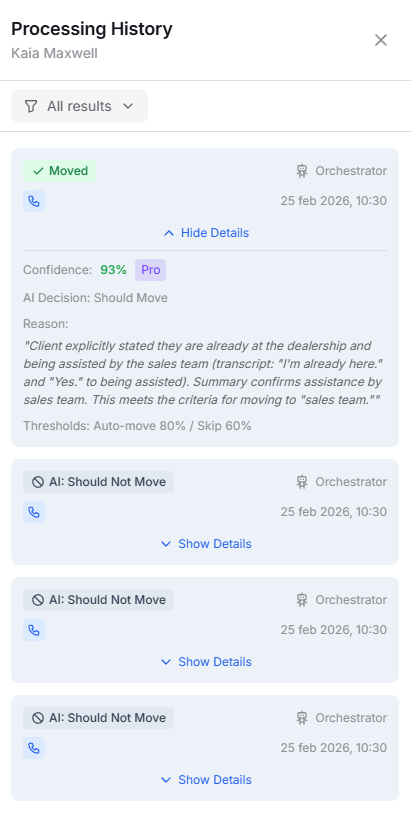
A customer's Processing History
The possible results
Every evaluation ends with one of these eight results:
For static transitions the panel shows which criteria were Met and which were Not, with
the real call values. For AI ones, it shows the confidence and the reasoning.
Common problems
No customers are entering the pipeline
No customers are entering the pipeline
In order of likelihood:
- The input node isn’t connected. If it shows Not connected, drag from the node to a stage.
- The node is inactive, or the pipeline isn’t in Active status.
- The conditions match nobody. By far the most common case: the Filter by agent filter points at an agent you deleted. Check it.
- The conversation hasn’t ended. Chat entry happens when the session is resolved, not when it starts (unless you chose On start).
- The customer was already in the pipeline and the re-entry policy blocks them, or they’re still in cooldown.
Customers enter but don't move
Customers enter but don't move
- Check the Processing History. If there are no entries, the evaluation never ran — the conversation probably didn’t end.
- If you see Conditions Not Met, the panel tells you exactly which criterion failed.
- If you see Orchestrator Disabled, enable it — and remember to tick Reactivate transitions.
- If you see Low Confidence repeatedly, your transition prompt is too vague or too broad. See writing good prompts.
- Check the transition is Active and that it leaves the stage the customer is in.
They move, but via the wrong transition
They move, but via the wrong transition
Static transitions are always evaluated before orchestrator ones, and within each group
Priority rules — the first match wins and stops evaluation.If an overly broad static transition is catching every case, tighten its conditions or lower
its priority.
A sequence didn't run
A sequence didn't run
- Was it a bulk move? Bulk moves do not trigger On departure or On arrival events. Only individual dragging does.
- Did they enter via a call? Call entries don’t trigger On arrival events.
- Was the Execution limit used up? It defaults to 1 per customer, for their whole stay in the pipeline.
- Are you using conditional sequences with no default branch? If no branch matches, nothing runs.
- Do the event conditions include a time range that doesn’t cover the moment it fired?
A sequence failed partway
A sequence failed partway
When an action fails, the whole sequence fails and the rest is cancelled. There’s no
automatic retry.Open View Activity on the customer, find the failed execution, and use Retry from
failure (continues from where it broke) or Retry all (starts over).Common causes: the customer has no phone number for a call, an invalid webhook URL, or a
WhatsApp template that stopped being approved.
I see customers I already deleted
I see customers I already deleted
This is known behavior: deleting a contact does not remove them from pipelines. Their
card stays on the board, counts toward the column total, and remains eligible for timers and
sequences.In the meantime, remove them from the pipeline explicitly with Remove from Stage in
addition to deleting the contact.
The AI keeps moving customers with the pipeline paused
The AI keeps moving customers with the pipeline paused
Correct, and expected: pausing the pipeline does not stop transitions. It only stops
input nodes and idle timers.To stop AI movement, disable the Orchestrator Agent. To stop static ones, deactivate them
individually.
What doesn’t exist yet
To save you the search:- There are no per-stage conversion, time-in-stage, or drop-off reports. The dashboard widget shows the per-stage count and one global conversion rate.
- A stage’s Idle alert doesn’t send notifications. Use an Idle timer event instead.
- There’s no campaign integration. A stage can place a single call, but not launch a campaign.
- Stage moves don’t appear in the Conversations timeline; they’re in the customer’s activity inside Salesflow.