

Atlas
The first tab. Ask for changes in plain language and Atlas applies them to the agent.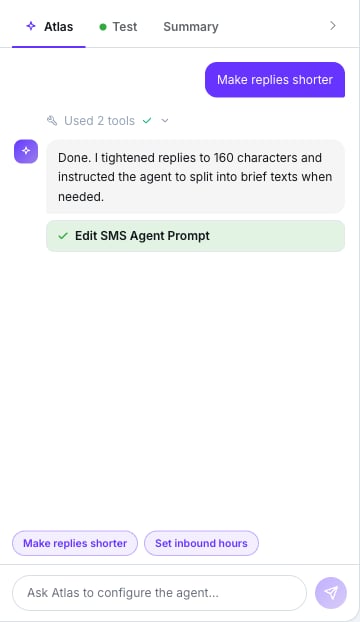
Quick actions and a completed change
- In create mode it builds the agent from your description and drops you on its page.
- In edit mode it updates the name, description, language, model, active state, agent type, first message, phone number, timezone, schedule, default-agent status (displacing the current default), auto close message, inactivity timeout, FAQ, variables, prompt text, attached tools, tags, disposition tags and memory settings.
- The Make replies shorter and Set inbound hours pills prefill common requests.
- It may ask clarifying questions before acting.
Test
The second tab. You type as if you were the customer.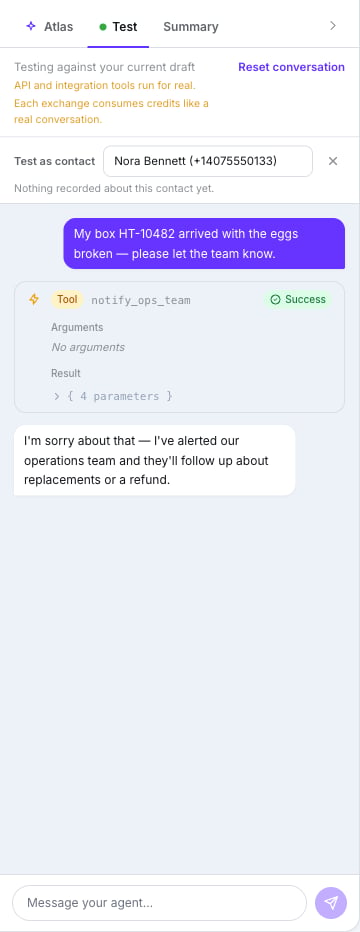
Testing the draft, with the two notices at the top
- Test as contact — pick a real contact to test with their memory and past conversations. The row then reads “Memory: …” or “Nothing recorded about this contact yet.” It only appears if you can read clients and their notes.
- Send SMS is simulated: no real text leaves.
- When the agent ends or hands over, a pill marks the spot — “The agent ended the conversation here.” or “The agent handed the conversation to a human here.” — and the composer reads “This conversation has ended — the agent has no way back from here. Reset to test again.” Press Reset conversation to start over.
Summary
The third tab. The checklist — Required to create or Required to save — lists Name, Agent Prompt (with its character count) and, for an outbound agent, First Message. Below it, a Configuration recap: Engine (Lumina), LLM Model, Language, Phone Number, Agent Type, Routing, Inactivity timeout, AI Memory, Status, Tools, FAQ and Disposition Tags.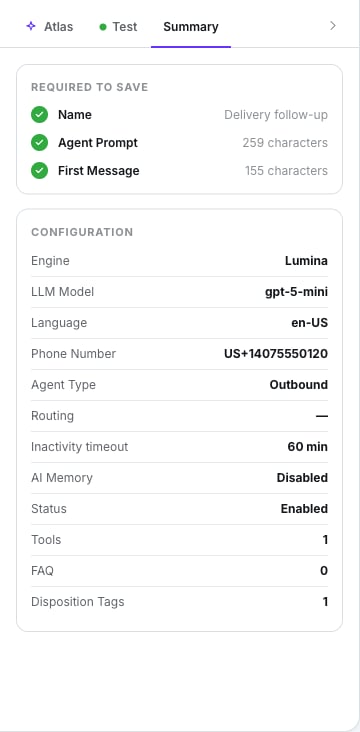
What's missing, and the configuration at a glance
Going live
The control is the Active / Paused toggle in the top bar. A paused agent isn’t picked for new inbound texts and can’t start chats. Duplicate lives on the agent list, not in the editor. It asks for a New Agent Name, a Phone Number (required if the source is inbound) and, for inbound copies, Default Agent or Time-Based Routing. Delete, also on the list, warns you: “This action cannot be undone.”What doesn’t exist
- Version history or rollback.
- Knowledge base or document upload.
- Analytics inside the editor — they’re under Analytics → SMS Statistics.
- Bulk actions on the agent list.
- Changing the engine.
Next step
The Conversations inbox
Where you watch it work — and step in.